Hybridoma Technology: Production of Monoclonal Antibodies
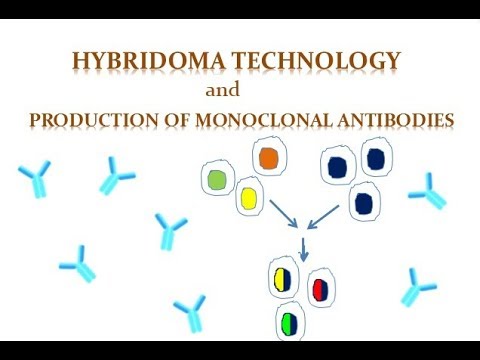
Polyclonal and Monoclonal Antibodies
Most antigens have multiple epitopes (An epitope, also known as an antigenic determinant, is the specific part of an antigen that is recognized and bound by an antibody) which induce activation, proliferation and differentiation of a variety of B-cell clones, and each derived B cell recognizes a particular epitope present on antigen.
The resulting serum antibodies are heterogeneous, comprising a mixture of antibodies, in which each one is specific for one epitome, this mixed population of antibodies are called polyclonal antibodies. Where as A monoclonal antibody is the antibody produced by a single clone of B lymphoid cells and this single type of antibody binds with only one specific antigen (The antigen that activate or sensitize the B-cell)In contrast, a monoclonal antibody is produced by a single clone of B-lymphoid cells and binds to only one specific antigen.

Hybridoma Technology
Hybridoma technology consists of the fusion of transient antibody-secreting B cells with immortal myeloma cells, resulting in cell lines that generate an unlimited supply of a particular monoclonal antibody.
This technique was developed in 1975 by Nobel laureates Georges Köhler and César Milstein.
Purpose of B Cell–Myeloma Fusion
For the production of Monoclonal Antibodies, Hybridoma cell is produced by the fusion of B Cell and Myeloma Cell, because both of these cell has their own properties. The result of this fusion is the formation of a single cell (Hybridoma cell) line that continuously produces one specific monoclonal antibody with longer life span.
- B cells (from an immunized animal):
- Produce specific antibodies.
- Short-lived in culture – they die after a few days and cannot divide indefinitely.
- Myeloma (Cancer) cells:
- Can divide indefinitely (immortal).
- Do not produce antibodies.
- Hybridoma Cell (fusion of both):
- Gains antibody specificity from the B cell.
- Gains immortality from the myeloma cell.

Result of fusion: A single cell line that produces one type of antibody (monoclonal) and can grow forever in lab conditions.
Production Steps of Monoclonal Antibodies
The production of monoclonal antibodies through hybridoma technology has various steps, these steps are described below:
1. Immunization of mice by a specific antigen:
Initially mice can be immunized with exogenous proteins. The purpose of immunization of mice is to sensitize the B lymphocytes (in the spleen of mice) against the specific antigen, for which the monoclonal antibodies will be produce. This is achieved by injecting micro or miligram of immunogen mixed with adjuvants (Freund’s Adjuvants or aluminum salts) or without adjuvants.2. Booster doses of antigenic protein:
Usually, a maximum of two or three booster injections of antigenic protein is recommended. Booster injection with very small amounts of antigen may improve B-cell sensitization to produced antibodies.3. Measurement of antibodies biosynthesis
Stimulation of B Cells and antibody production during the experiment can be monitored by obtaining and evaluating a blood sample for antibodies in the serum4. Collection of splenocytes (Splenocytes Preparation):
After appropriate antibody titer (concentration) the mice were sacrificed and their spleens removed aseptically and harvested by washing the spleen. pulp with serum-free medium.5. Myeloma Cell selection:
Myeloma cells lines are selected from the Mice, rats or from human sources. Myelomas can be induced in a few strains of mice by injecting mineral oil into the peritoneum. and these cells are referred to by the abbreviation MOPC (mineral oil plasmacytoma).6. Fusion of Cells for Production of Hybridoma cells
Fusion can be achieved by incubating the suspension of two cell types by using inactivated enveloped virus called Sendai virus or by using Poly Ethylene Glycol (PEG). Both of which promote the fusion of plasma membrane and this brought cytoplasm and nuclei of both cells to gather to form a single hybrid cell.7. Selection of Hybridoma cells
After fusion by Sendai virus and PEG, only a small portion of cells gets fused togather. For the selection of only hybrid cells, a selective media called HAT medium is employed. After fusion, the cells were transferred to the HAT medium in a culture flask. This step is called HAT selection, because after culturing in HAT medium only hybrid cells can survive, unfused B cells and unfused Myeloma cells can not survive in this medium. All live cells are hybridomas.8. Selection of antigen specific hybridoma cells
As the mice has several types of B-cells, thus several types of hybridoma cells may generate through fusion of each type of B-cells. In this regard it is necessary to identify the Hybridoma cell which is producing the desires antibody. /p> After HAT selection, hybridoma cells are separated as single cell and each single hybridoma is transferred to separate tubes filled with Cell culture media for production of their corresponding antibodies (because each type of hybridoma produces specific type of antibody). After 10-14 days the growing hybrids are tested for the production of antibody to the antigen.9. Checking for Monoclonality
Each hybridoma cell produces their specific type of antibody, The next step is screening of only those hybridomas that produce desired antibodies in response to that particular antigen which is initially used to sensitize the mice. Antibodies produced by hybridoma cells in culture media are assayed by ELISA (Enzyme Linked Immuno Sorbent Assay) or RIA (Radio Immuno Assay).10. Selection of Specific hybridoma
The hybridoma cell which produce the desired antibody is selected and isolated, and transferred in another culture vessel for cell division and to produce mass population of that single type of hybridoma.11. Propagation of Selected hybridoma
The hybridoma cells can propagated by many ways:-
1. Hybridoma are transferred in culture flask (this method is low yielding),
2. Hybridomas cells are transferred to mice peritoneal cavity. There the hybridoma cells Grows and produces monoclonal antibodies. These antibodies are then isolated from mice ascites fluid through chromatography.
3. Hybridoma cells are grown on large fermenters for higher production.
12. Purification of Antibodies Monoclonal
The hybridoma cell which produce the desired antibody is selected and isolated, and transferred in another culture vessel for cell division and to produce mass population of that single type of hybridoma. antibodies may need to be purified before they are used for a variety of purposes. Antibodies can be purified by anyone of the following techniques:-
(I) Ion-exchange chromatography;
(ii) Antigen affinity chromatography


HAT Selection
During the fusion process, three types of cells are present in HAT medium:
- unfused myeloma cells that are deficient in an enzyme called HGPRT,
- unfused spleen cells, and
- fused hybridoma cells.
When these three types of cells are placed in HAT medium:
- Unfused spleen cells are died because they have shorter life span and they do not replicate in HAT medium.
- Unfused myelomas also died in media containing HAT, because The aminopterin present in the medium blocks the de novo DNA nucleotide synthesis pathway of unfused myeloma cells. When the de novo pathway is blocked, cells will then utilize the salvage pathway as an alternative means to replicate (only if hypoxanthine and thymidine are present). However, these myelomas are unable to do so since they are deficient in an enzyme called HGPRT, which is required for the salvage pathway. Hence, myelomas are unable to replicate in HAT medium.
- Only hybridomas survive. Hybridomas inherit a functioning HGPRT enzyme from the spleen B-cells, so even though the de novo pathway is blocked (due to Amenopterin), they can still use the salvage pathway to replicate.
